

Start from what you need
You’re running a fleet and you want clear sightlines without fuss. For many operators — from shuttle services to municipal contractors — a 4-channel mobile DVR is the straightforward answer to get four-camera monitoring working reliably. If your brief is specifically on passenger safety, route verification and incident clarity, consider how a system ties into school bus fleet management early on: that focus changes camera placement, retention time and remote access expectations.
What a 4-channel DVR actually delivers for drivers and operators
Think user needs first. A quality 4-channel DVR gives these practical outcomes:- Synchronized, time-stamped video from four angles so you can reconstruct events.- Local storage with overwrite logic so footage is retained without constant manual housekeeping.- Basic telematics inputs (GPS, speed, ignition) to correlate driving data with video.- Simple playback and export routines for quick reporting.These are the features drivers and managers notice day-to-day; they want dependable footage, not a menu of options they never use.
How to match camera placement to your operations
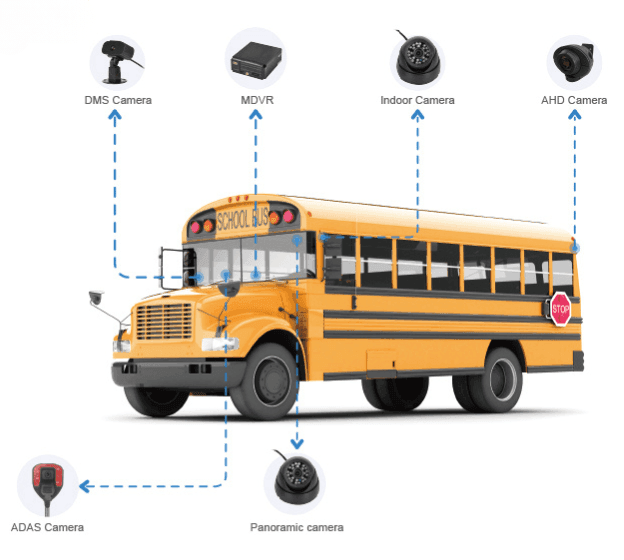
Place cameras where they answer questions you actually get asked. Common four-camera layouts that work for commercial vehicles:- Front-facing (road view) — for liability and incident verification.- Driver-facing — behaviour monitoring, distraction evidence.- Rear view — reversing incidents and curbside events.- Door/aisle or curbside — passenger boarding, seat-belt checks or cargo area.Pick lenses and fields of view to avoid blind spots. If you’re switching from single-camera kits, start with driver and front views first; you’ll see immediate value.
Installation and configuration tips that save time
Small choices make a big difference. Use vibration-rated mounts and route power to an accessory circuit with ignition sensing so recording follows duty cycles. Set recording modes by priority — continuous for front and driver, motion-triggered for rear or aisle — to stretch storage. Keep your firmware up to date and lock down user accounts; an unsecured DVR is just a hard drive in a bus.
Common pitfalls operators stumble over
Avoid these mistakes:- Assuming all cameras are equal: low-light performance and compression codecs vary. Test before you buy.- Underestimating storage needs: 1080p at high bitrates fills cards fast. Plan retention by incident needs, not vendor promises.- Neglecting synchronization: unsynced clocks mean matching footage to GPS becomes guesswork.- Overcomplicating access: if managers can’t retrieve clips without IT, the system becomes shelfware.Operators in Gauteng province have seen uptime improve simply by standardising camera mounts and retention policies fleet-wide — small discipline, big effect.
When remote access and fleet software matter
Remote pull and live-view save hours. If you need real-time alerts (collision, harsh braking), choose a DVR that supports cellular telemetry or pairs with a telematics gateway. That’s where integrated offerings shine; platforms designed for school routes reduce admin time by tagging events automatically. For fleets needing both video and centralised management, explore dedicated vendors that bundle device management and cloud indexing like established school bus fleet management solutions.
Alternatives and what to evaluate
If a 4-channel unit looks limiting, you have options: multi-channel units with scalable inputs, networked IP camera systems, or distributed dashcams with central aggregation. Evaluate on three concrete criteria: reliability under vibration and heat, ease of clip export, and how the system ties to operational workflows (reporting, evidence handling). Don’t pick a solution on price alone; weak hardware or clumsy software costs time.
Final synthesis: practical steps to get it right
Choose a 4-channel DVR when you need straightforward four-angle coverage that drivers can trust and managers can use without drama. Test a pilot vehicle, lock down placement, standardise retention and train drivers on basic checks. That pragmatic approach reveals where upgrades matter and where you can save. Experienced installers and fleet managers prefer systems that behave predictably; that discipline is the exact kind of work BSJ designs its offerings around, so fleets get footage they can act on, every day.
