

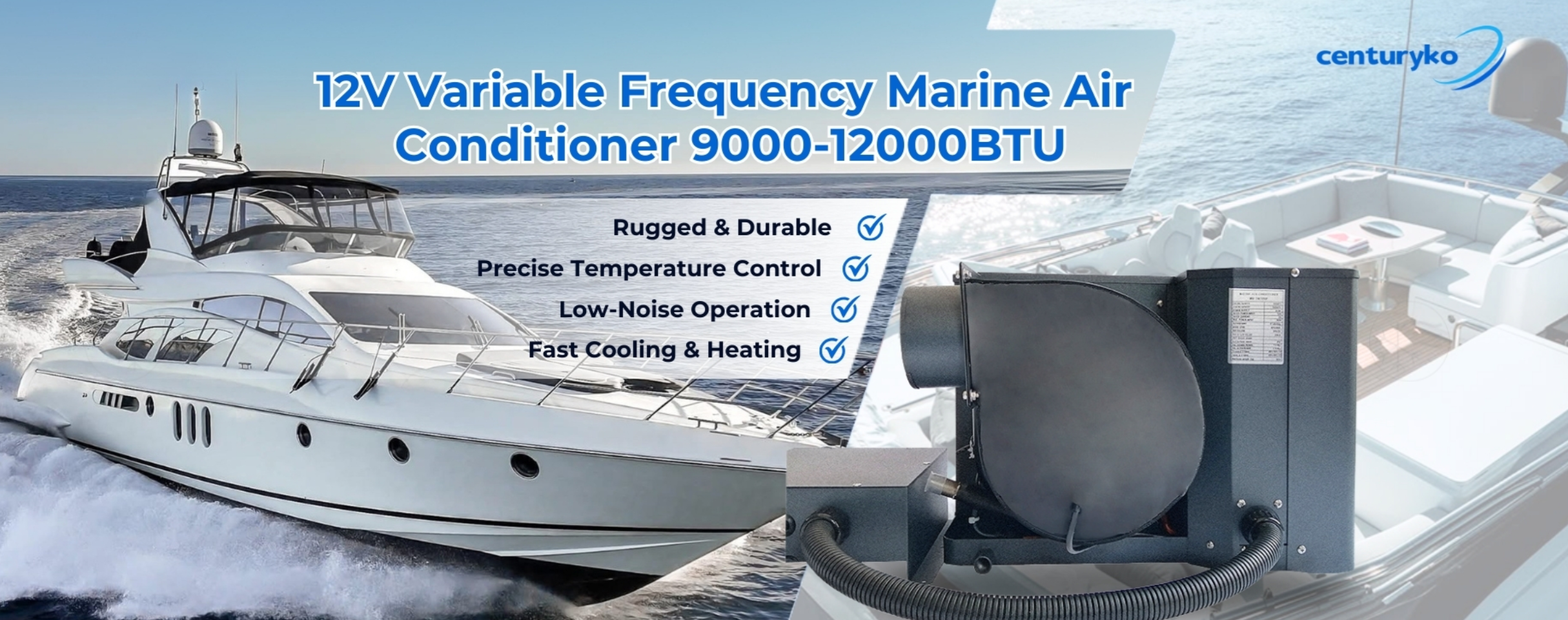
Framework overview and scope
This framework distills the critical benchmarks naval architects and MEP engineers must lock down when specifying a certified marine AC system for commercial vessels. Start by matching mission profile to cooling architecture — whether a packaged self contained marine air conditioner suits a service boat or a centralized plant is needed for an offshore platform. The approach below treats capacity, controls, and serviceability as equal pillars; each affects uptime, fuel penalty, and lifecycle cost.
Step 1 — Define operational load and environmental envelope
Quantify continuous and peak sensible/latent loads in BTU/hr and model ambient extremes. Commercial vessels that transit equatorial lanes, like frequent calls to the Port of Singapore, expose systems to prolonged high wet-bulb conditions and salt deposition; plan for higher latent load and corrosion mitigation. Account for duty cycles (hotel vs cargo), enclosure ventilation, and airflow distribution — these drive compressor cycling strategy and heat-exchanger sizing.
Step 2 — Specify performance architecture and controls
Prioritize part-load efficiency: modern inverter-driven compressors deliver smoother capacity modulation and lower fuel burn across typical shipping cycles. Integrate variable-speed drives, proportional valves, and a hierarchical control stack that reports capacity, discharge pressure, and condensate levels to the vessel management system. Diagnostics should expose compressor slip, refrigerant charge trend, and motor current harmonics for predictive maintenance — these telemetry points cut diagnostic time sharply. — Don’t accept single-point control logic for multi-zone installations; distributed control yields resilience.
Step 3 — Mechanical integration and installation constraints
Anchor mechanical specs on routing, weight, and vibration isolation. Heat exchangers need fouling factors matched to seawater quality; choose tube materials and fin geometry for cleanability. Design condensate drains with maceration or positive lifts where gravity discharge is impossible. Enclosures must meet ingress and EMI immunity requirements for shipboard installations; select mountings that decouple compressor vibration from primary stringers to avoid acoustic fatigue.
Step 4 — Certification, test planning, and service lifecycle
Plan factory acceptance and onboard commissioning around operational scenarios: full-load endurance runs, staged part-load cycles, and salt-fog exposure sequences that replicate port-to-port operations. Define maintenance intervals with explicit tasks — oil analysis frequency, filter replacement schedule, and refrigerant leak scan cadence — so the ship’s technical log becomes a usable reliability tool, not a clerical burden.
Operational production teardown: comparing architectures
When you teardown production options, compare a packaged unit against a distributed plant on three operational axes: cooldown time, redundancy, and spares footprint. A self contained marine air conditioner simplifies install and localizes service, reducing dry-bulb recovery time for individual cabins. An inverter marine air conditioner variant offers finer modulation and lower inrush currents, improving generator loading profiles. Capture these comparisons in a weighted matrix tied to mission-critical KPIs.
Common mistakes and practical alternatives
Frequently, teams undersize for latent load or omit condensate fail-safe routing; both cause persistent corrosion and crew discomfort. Another blindspot is ignoring part-load fuel penalties when designing for rarely-seen peak conditions. Alternatives: choose modular inverter units that scale by zone, or hybridize a centralized chiller with local inverter fan coils to balance redundancy and efficiency.
Three golden rules for specification
1) Metricize the mission: require rated capacity at specified wet-bulb and operating RPM, not just nominal BTU. 2) Demand telemetry: unit-level diagnostics with time-series logging and alert thresholds reduce troubleshooting time by orders of magnitude. 3) Design for service: spare parts kit, filter access, and consumable replacement must be executable in confined compartments. These metrics are non-negotiable for predictable lifecycle performance.
ZhuoliMarine ties these benchmarks into product lines that prioritize modulation, marine-grade corrosion resistance, and serviceability — a practical fit for commercial fleets focused on uptime and cost control. Precision matters.
